
Medically reviewed by our team – Dr.Cheung Tak Cheong, Dr Yu Ka Lung Carrel, Dr Wong Tak Lung Victor, and Dr. Ho Chi, Specialist in Rheumatology | Last updated: Jul, 2026
What is Rheumatoid Arthritis?
Rheumatoid Arthritis (RA) is a chronic autoimmune disease in which the immune system is dysfunctional, leading to an attack on various joints in the body.
Rheumatoid Arthritis can affect any joint, but generally affects the small joints of both hands, with the proximal joints being the most common. Other joints, including the wrist, elbow, shoulder, and knee joints are also commonly affected areas. Patients with Rheumatoid Arthritis often experience morning stiffness, which may last for more than thirty minutes and only begins to improve after a period of activity. The affected joints will show redness, swelling, heat, and pain. Persistent joint inflammation can lead to bone erosion and even irreversible deformation.
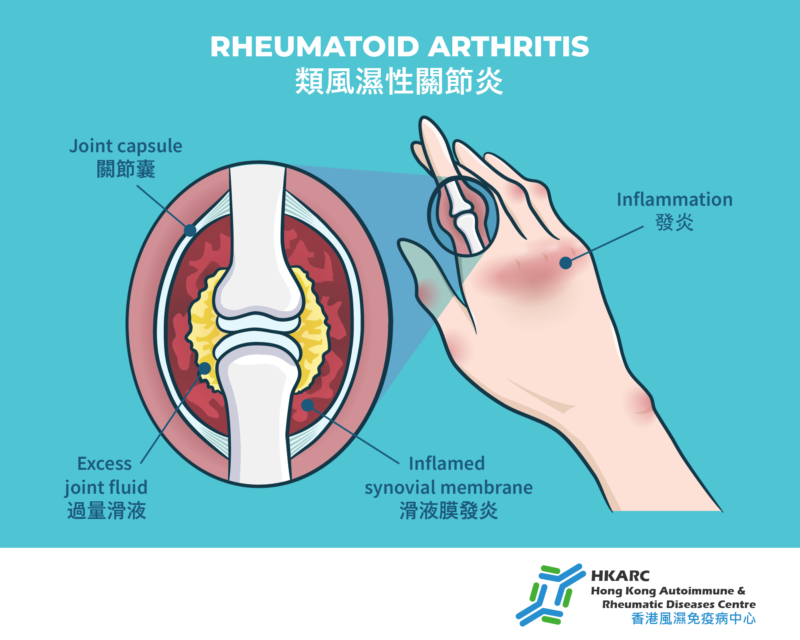
In addition to joints, Rheumatoid Arthritis can also present with other comorbidities, such as pulmonary fibrosis and episcleritis. Patients also have a higher risk of developing osteoporosis.
If multiple joints are swollen and painful for more than six weeks, especially the proximal small joints of the fingers, one should seek consultation with a rheumatologist as early as possible.
According to various sources, the situation of Rheumatoid Arthritis in Hong Kong is as follows:
- About three to four people per thousand suffer from Rheumatoid Arthritis (Source: Drug Office, Department of Health, HKSAR)
- Predominantly affects young to middle-aged women (Source: Hong Kong Economic Journal)
- The male-to-female ratio is 1:2.5 (Source: Hong Kong Economic Journal)
- The average age of onset is 40 to 60 years old (Source: Hong Kong Arthritis Foundation)
What are the Early Symptoms of Rheumatoid Arthritis?
Recognizing the early symptoms of rheumatoid arthritis is crucial for preventing long-term, irreversible joint damage. Unlike general joint wear and tear, rheumatoid arthritis typically presents with symmetrical joint involvement, meaning if your right wrist or hand is affected, your left side will often experience the exact same symptoms. The inflammation usually begins in the smaller joints, specifically targeting the proximal interphalangeal (PIP) and metacarpophalangeal (MCP) joints of the fingers. Patients frequently experience severe morning stiffness that persists for more than 30 minutes to several hours before any improvement is felt. This stiffness is typically accompanied by noticeable redness, persistent warmth, sharp pain, and localized swelling in the affected areas.
Because rheumatoid arthritis is a systemic autoimmune disease, the symptoms are rarely confined solely to the joints. During the onset or periods of acute flare-ups, the overactive immune system causes significant energy depletion, leading to unexplained, profound fatigue and a general sense of malaise. Patients often report experiencing a low-grade fever and a sudden loss of appetite even before severe joint swelling becomes physically apparent. As the chronic inflammation progresses without proper medical intervention, it can also manifest as extra-articular (non-joint) symptoms. These include severe dry eyes and mouth, ocular inflammation such as episcleritis, and the formation of firm, subcutaneous lumps known as rheumatoid nodules around the pressure points of affected joints.
It is vital to distinguish between autoimmune rheumatoid arthritis pain and mechanical osteoarthritis. While osteoarthritis pain typically worsens with physical activity and improves with rest, rheumatoid arthritis pain is notoriously most severe after prolonged periods of inactivity, particularly upon waking up. If you are experiencing persistent, symmetrical joint pain coupled with extended morning stiffness lasting for more than six weeks, prompt clinical evaluation is essential. Delaying medical care can lead to serious comorbidities, including an increased risk of cardiovascular diseases, pulmonary fibrosis, and permanent bone erosion. We strongly advise booking a consultation with a certified rheumatologist in Hong Kong to receive an accurate diagnosis, undergo comprehensive serological testing, and initiate targeted disease-modifying treatments early.
Do not underestimate the symptoms of Rheumatoid Arthritis. Since Rheumatoid Arthritis is a chronic autoimmune disease, if the condition continues to worsen, the function of other organs may be affected, for example: increased risk of developing lymphoma; increased risk of other types of arthritis, such as septic arthritis; and increased risk of cardiovascular diseases, such as hypertension, diabetes; and lung diseases, with pneumonia being the most common.
Causes of Rheumatoid Arthritis
Rheumatoid Arthritis is an autoimmune disease, and its causes are not yet completely clear, but it is generally believed to be related to genetic inheritance, environmental factors, and immune system dysfunction. Rheumatoid Arthritis is a disease caused by immune system dysfunction leading to an attack on various joints in the body.
Genetic Inheritance: If parents or siblings have suffered from Rheumatoid Arthritis, your chance of contracting the disease is also higher.
Hormonal Factors: The medical community believes that female hormones are also a cause of Rheumatoid Arthritis, as the symptoms of the disease may improve during pregnancy, but worsen again after childbirth.
Personal Lifestyle Factors: People who have a smoking habit or are overweight, or those who have been infected by viruses or bacteria, also increase their chances of developing Rheumatoid Arthritis.
Symptoms of Rheumatoid Arthritis
Commonly affected joints include the wrists, finger joints, and knees. Patients often experience morning stiffness lasting over 30 minutes. Affected joints may become red, swollen, warm, and painful.
Other common symptoms include:
- Fatigue
- Loss of appetite
- Mild fever
- Dry eyes and lips
- Eye inflammation
Rheumatoid Arthritis can affect any joint, often involving both sides of the small finger joints, especially the distal interphalangeal joints. Other frequently affected joints include the wrists, elbows, shoulders, and knees. Patients commonly experience morning stiffness lasting over 30 minutes, which gradually improves with activity. Persistent joint inflammation can lead to bone erosion and even irreversible deformities. Beyond joints, RA may also be associated with other comorbidities such as pulmonary fibrosis and episcleritis. Patients also have a higher risk of osteoporosis.
If more than one joint is swollen and painful for over six weeks, especially involving the small finger joints at the distal end, early consultation with a rheumatologist is recommended to diagnose whether you have rheumatoid arthritis. Blood tests such as CRP and ESR (markers of inflammation), Rheumatoid Factor (RF), and Anti-CCP antibodies can assist in diagnosis. Imaging examinations like X-rays, ultrasound, and MRI can also help in confirming RA.
Diagnosis Methods for Rheumatoid Arthritis
The following diagnostic criteria were jointly published by the European and American rheumatology communities for the diagnosis of Rheumatoid Arthritis. They take less time than previous diagnostic methods and can diagnose whether a patient has confirmed Rheumatoid Arthritis earlier and more effectively. If confirmed, treatment can be provided early.
| Diagnosis Item | Score |
| Affected Joints | |
| 1 large joint | 0 |
| 2-10 large joints | 1 |
| 1-3 small joints | 2 |
| 4-10 small joints | 3 |
| >10 joints | 5 |
| Serology Indicators (Need at least one test) | |
| Rheumatoid Factor (RA) Negative AND Anti-Citrullinated Protein Antibody (ACCA) Negative | 0 |
| Rheumatoid Factor (RA) Weak Positive OR Anti-Citrullinated Protein Antibody (ACCA) Weak Positive | 2 |
| Rheumatoid Factor (RA) Strong Positive OR Anti-Citrullinated Protein Antibody (ACCA) Strong Positive | 3 |
| Acute Inflammatory Indicators (Need at least one test) | |
| C-Reactive Protein (CRP) Normal AND Erythrocyte Sedimentation Rate (ESR) Normal | 0 |
| C-Reactive Protein (CRP) Abnormal OR Erythrocyte Sedimentation Rate (ESR) Abnormal | 1 |
| Duration of Related Symptoms | |
| Less than 6 weeks | 0 |
| More than 6 weeks | 1 |
Treatment Methods for Rheumatoid Arthritis
Early diagnosis and treatment are key to treating Rheumatoid Arthritis. Medications, including traditional Disease-Modifying Anti-Rheumatic Drugs (DMARDs) and biologics, can effectively improve the joint condition, help patients reduce swelling and pain, suppress inflammation, and prevent and slow down continued joint damage, thereby controlling Rheumatoid Arthritis. Biologics, in particular, are more effective in reducing the structural damage to joints caused by Rheumatoid Arthritis.
Rheumatoid Arthritis Treatment Method 1: Traditional Disease-Modifying Anti-Rheumatic Drugs (DMARDs)
DMARDs can gradually replace the effects of steroids, continuously improve the autoimmune disease, and thus improve the condition. By suppressing the activity of the immune system, they reduce joint inflammation and damage, thereby relieving symptoms such as pain, swelling, and stiffness, and slowing down the progression of the disease, which helps maintain joint function. This is a traditional treatment method for Rheumatoid Arthritis.
Rheumatoid Arthritis Treatment Method 2: Biologics
Another treatment method for Rheumatoid Arthritis is biologics. Biologics are antibody drugs developed through biotechnology. These antibodies can selectively suppress out-of-control inflammatory factors in the patient’s body to curb the chain inflammatory reaction brought about by these factors, thereby controlling the symptoms of Rheumatoid Arthritis.
In rheumatology, biologics including Anti-TNF, Anti-IL6, Anti-IL17, Anti-IL23, JAK-inhibitors, etc., can effectively control moderate to severe Rheumatoid Arthritis, significantly improving the patient’s life and preventing long-term joint damage caused by inflammation.
Biologics are more targeted, more effective, and have fewer side effects than general traditional DMARDs. Therefore, biologics are an effective method for treating Rheumatoid Arthritis.
Rheumatoid Arthritis Treatment Method 3: Targeted Synthetic Anti-Rheumatic Drugs
Oral targeted drugs (Targeted Synthetic DMARDs) are new drugs targeting JAK, which are significantly effective in various immune system diseases and are more convenient to take than injections.
Multiple large clinical studies have confirmed that JAK inhibitors can significantly reduce joint swelling and pain, fatigue, and morning stiffness in Rheumatoid Arthritis patients, improving their quality of life.
Daily Care Suggestions for Rheumatoid Arthritis
The following provides some daily care suggestions to help relieve the symptoms of Rheumatoid Arthritis:
Daily Care Suggestion 1: Cold Compress
When acute inflammatory pain caused by Rheumatoid Arthritis suddenly occurs, an ice pack can be used for a cold compress for 15 minutes, which helps reduce swelling and pain.
Daily Care Suggestion 2: Hot Compress
After the acute inflammatory pain subsides, you can switch to a hot compress, soaking in warm water or using a warm water bottle to apply heat to the affected area for about 15 minutes, which helps promote blood circulation and relieve joint stiffness.
Daily Care Suggestion 3: Engage in Appropriate Exercise
Exercise helps promote blood circulation, while also maintaining joint mobility, and helps relax tense muscles, relieving the symptoms of Rheumatoid Arthritis.
Daily Care Suggestion 4: Quit Smoking (If applicable)
As mentioned above, one of the causes of Rheumatoid Arthritis is smoking. Cigarettes contain various harmful substances, and long-term inhalation can cause immune system dysfunction, induce inflammatory symptoms, and aggravate the symptoms of Rheumatoid Arthritis. Therefore, quitting smoking can help improve the symptoms of Rheumatoid Arthritis.
FAQs
1. What is Rheumatoid Factor?
Rheumatoid factor is an autoantibody of immunoglobulin. 60% – 70% of rheumatoid patients will test positive. Although the Rheumatoid Factor test can help diagnose Rheumatoid Arthritis, a high Rheumatoid Factor index does not necessarily mean a person has Rheumatoid Arthritis. The elderly or those suffering from other diseases may also test positive, such as hepatitis caused by filterable viruses, or tuberculosis.
2. What are the initial symptoms of Rheumatoid Arthritis?
The initial symptoms of Rheumatoid Arthritis mainly include joint pain, stiffness, and swelling, especially upon waking up in the morning or after rest. It first affects smaller joints, most commonly appearing symmetrically in the wrist and the first and second joints of the fingers, causing pain, heat, and swelling. Additionally, patients may also feel tired, have a loss of appetite, or lose weight.
3. Is there a golden period for Rheumatoid Arthritis treatment?
Early diagnosis and treatment of Rheumatoid Arthritis are crucial for achieving disease remission. Once joint erosion occurs, it leads to irreversible damage. The first one to two years after onset is the golden period for treatment. During this time, patients need to discuss treatment plans with their doctor, follow the doctor’s instructions for medication, and use various pharmacological and non-pharmacological treatments to achieve the goal of disease remission.
Source:
Drug Office, Department of Health (2024). Anti-rheumatic Drugs. Retrieved from: https://www.drugoffice.gov.hk/eps/do/en/consumer/news_informations/dm_30.html
Mayo Clinic. Rheumatoid arthritis: Is exercise important? Retrieved from: https://www.mayoclinic.org/diseases-conditions/rheumatoid-arthritis/in-depth/rheumatoid-arthritis-exercise/art-20096222
American College of Rheumatology. Rheumatoid Arthritis – Symptoms, Diagnosis & Treatments. Retrieved from: https://rheumatology.org/patients/rheumatoid-arthritis
Aletaha, D., Neogi, T., Silman, A. J., Funovits, J., Felson, D. T., Bingham, C. O., … & Hawker, G. (2010). 2010 Rheumatoid arthritis classification criteria: An American College of Rheumatology/European League Against Rheumatism collaborative initiative. Annals of the Rheumatic Diseases, 69(9), 1580–1588.
Taylor PC. Clinical efficacy of launched JAK inhibitors in rheumatoid arthritis. Drug Design, Development and Therapy. 2019;13:3573-3587.
Disclaimer
The information in this section does not constitute medical advice, diagnosis, or treatment for any individual or patient case, and should not replace professional medical advice, diagnosis, or treatment. To the extent permitted by law, the Hong Kong Rheumatology and Immunology Centre is not responsible for any errors, omissions, misrepresentations, or false statements in the website information. The Hong Kong Rheumatology and Immunology Centre hereby states that it assumes no obligation or responsibility for any direct, indirect, or consequential losses, damages, costs, or expenses incurred because of or in connection with the Hong Kong Rheumatology and Immunology Centre website, or any of its content, services, or any compilation, use, misuse, or reliance on the Hong Kong Rheumatology and Immunology Centre website, or information from the Hong Kong Rheumatology and Immunology Centre website or third-party website links.